ROXID
.png?width=1800&height=900&name=Roxid%20Case%20study%20Images%20(2).png "Roxid Digital Heritage Image")
The company
ROXID is a research-led start-up founded by Roxana Montazerian, working to transform the way cultural heritage sites are managed and conserved. The company was born out of a research project in heritage conservation where Roxana identified a major challenge: large amounts of time and money were being lost to duplicated work and inefficient collaboration.
ROXID’s mission is to enable better decision-making across the sector by providing organisations with access to reliable, structured data on conservation activity—ultimately helping preserve heritage sites more sustainably and cost-effectively.
To support this vision, ROXID is developing an intelligent platform that collects, analyses and presents conservation project data in a user-friendly way. The platform is designed to be accessible to professionals from across the heritage field, from archaeologists and engineers to historians and project managers.
The challenge
A major barrier to delivering this platform was ROXID’s manual approach to data collection. Gathering publicly available conservation data from online sources was slow, resource-intensive, and prone to human error. The company wanted to know whether this process could be automated using AI—making it faster, more accurate, and scalable.
This project followed on from an earlier collaboration with NICD, delivered through an Arrow-funded feasibility study. That initial work explored various techniques for data extraction. The goal now was to consolidate those experiments into a single, functional pipeline that could be deployed in-house and form part of ROXID’s working system.
“We had been manually gathering data on conservation work for heritage buildings, but the process was time-consuming and unsuitable as we scaled. To work more efficiently and make better use of our resources, we set out to automate the workflow and significantly reduce the need for manual input.”
Roxana Montazerian, Founder, ROXID
The collaboration with the National Innovation Centre for Data
The National Innovation Centre for Data's (NICD) data science team worked closely with ROXID to design and build a working pipeline based on the work done in the earlier Arrow project. The team reviewed and assessed the exploratory scripts from the feasibility phase and developed a streamlined, modular pipeline that ROXID could run locally.
Key steps in the project included:
- Unifying existing scripts into a single pipeline that could extract data
- Further development and testing of extraction capabilities to automate data collection
- Engineering LLM prompts for data extraction from unstructured content
- Using an open-source language model, allowing everything to run on ROXID’s own hardware
- Outputting structured CSV files
- Creating semi-interactive visualisations
“Large language models are used in such a breadth of fields these days, it was nice to see how they can be utilised within the field of heritage conservation. It was nice to take the work that myself and others carried out during the Arrow project with ROXID and develop it further into a functional pipeline that Roxana can take forward within her company. It was enjoyable to explore the use of open-source large language models and how they compare, and I wish ROXID all the best in their future ventures.”
Dr Georgia Atkinson, Data Scientist, National Innovation Centre for Data
A cost-conscious, local solution
A central requirement for ROXID was to ensure the solution worked entirely within their existing infrastructure—without relying on paid APIs, third-party platforms or cloud-based tools. NICD designed the system so it could run on ROXID’s local machines using open-source tools, avoiding any additional overhead or subscriptions.
Roxana Montazerian highlighted the importance of these cost saving measures:
"The NICD team engaged in extensive discussions to determine the most efficient and cost-effective approach to delivering the project. They were committed to leveraging our existing equipment, which allowed us to avoid outsourcing and keep expenses down — a crucial consideration for us as a start-up."
By using a platform that enables large language models to run locally and selecting a suitable large language model given RAM restrictions, NICD ensured that ROXID could maintain and expand the solution without incurring extra costs.
Dr Chris Wedge, key NICD data scientist working on this project, added:
"This was an exciting opportunity to collaborate with ROXID on their heritage sites information project. As the client required an open-source solution the project provided an opportunity to explore the use of smaller local language models, rather than interacting with the API of larger GPT models as in previous projects.
While we met with Roxana weekly to provide project updates a particular highlight for me was the final day of the project, learning more about ROXID’s products and scoping a follow-on project as part of a Project Success Workshop, and getting the code up and running on the client’s own machine during the code handover session.”
How we worked together
The project was highly collaborative, with regular meetings allowing both teams to share updates, solve challenges and iterate on the design. ROXID played an active role in guiding development priorities and testing outputs.
To ensure long-term sustainability, the project also included:
- A two-hour upskilling session for ROXID on topics like GitHub, version control and good coding practices
- A code handover session, where the solution was successfully tested on ROXID’s own machines
- A Project Success Workshop, where the team reviewed outcomes and scoped future areas for development
“The collaboration with NICD was really productive. I was able to watch the team explore different ideas, debate technical decisions, and explain why they made certain choices. That transparency helped me build confidence in the solution and also taught me a lot about LLMs and data science more generally.”
Roxana Montazerian, Founder, ROXID
The impact
The project successfully delivered a fully functional pipeline that met ROXID’s original goals. The new pipeline allows them to automate data collection and extraction, reducing the need for manual effort and improving the consistency of their datasets.
Benefits include:
- A scalable, local solution to replace time-consuming manual processes
- Cleaner and more reliable data for use in heritage project planning
- Timeline visualisations to help interpret conservation activity across sites
- A platform for future expansion and automation
- A cost-efficient build using in-house equipment and open-source tools
The project has also increased ROXID’s internal capacity, with Roxana and her team gaining hands-on experience with LLMs, open-source AI tooling, and collaborative development workflows.
“Working with NICD helped us understand what kind of technical skills we’ll need in the team going forward. We now have a solid base to continue development and build new features on top of this pipeline.”
Roxana Montazerian, Founder, ROXID
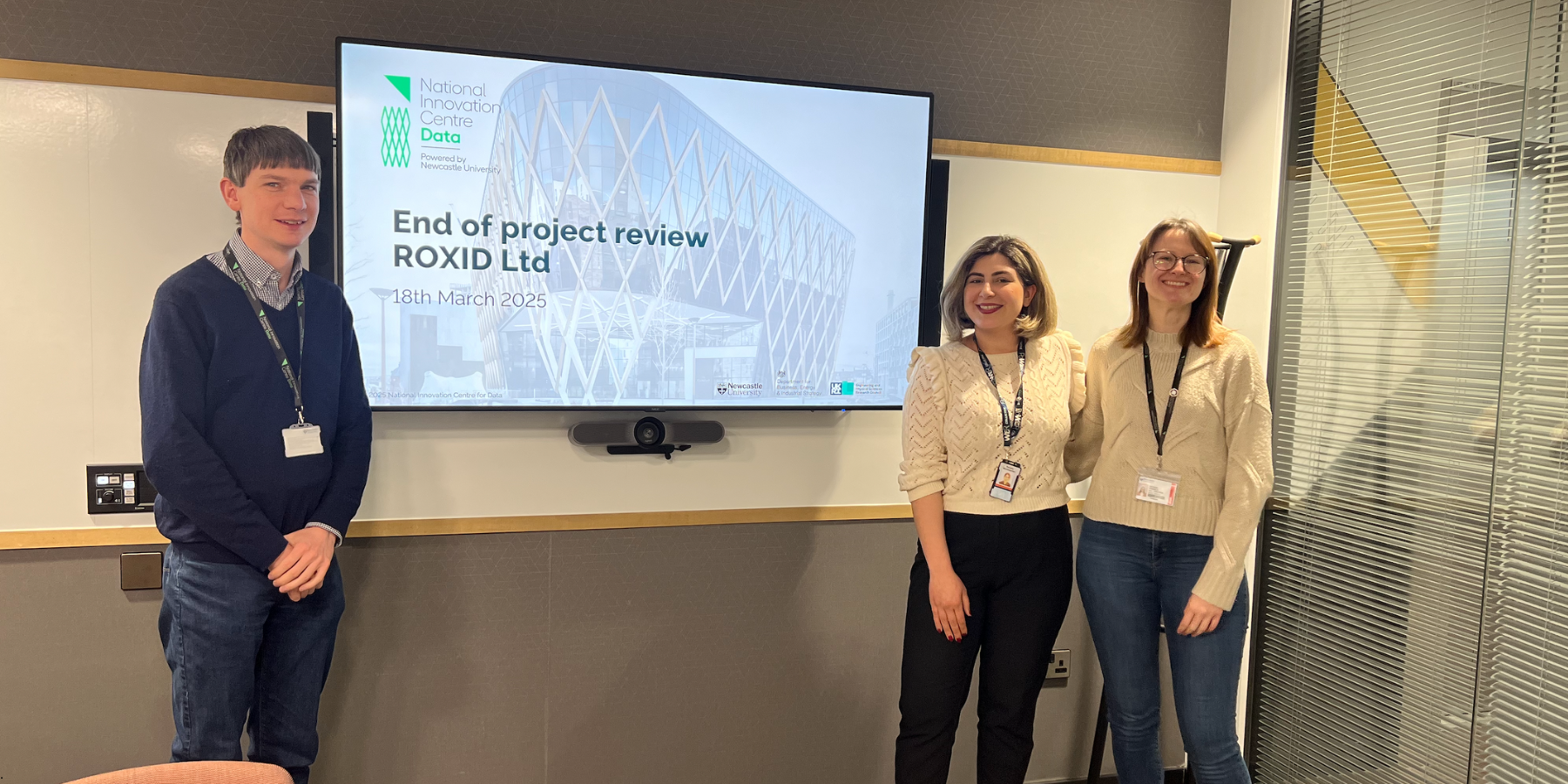
.png?width=1800&height=900&name=Roxid%20Case%20study%20Images%20(1).png "Dr Chris Wedge, Data Scientist, NICD (left), Roxana Montazerian, Founder, ROXID (middle), Dr Matt Edwards, Former Senior Data Scientist, NICD (middle), Dr Antonia Kontaratou, Data Scientist, NICD (right)")
What's next
ROXID plans to continue developing the pipeline further and integrate it into their wider platform in the months ahead. They have already identified new opportunities to automate other manual processes using LLMs—and are exploring future collaboration opportunities with NICD.
Roxana Montazerian adds:
"We already know that this approach works and fits with our internal systems. The next step is to expand it to cover more types of data and continue developing new features. We’re definitely looking to work with NICD again."
Final thoughts
“NICD has a very good team—not only data scientists but also researchers. They’re open to exploring new ideas, and their understanding of R&D projects and data science is really strong. Most importantly, they were genuinely engaged and interested in understanding our business challenges so they could build something that really fit our needs.”
Roxana Montazerian, Founder, ROXID
To discover more about ROXID, visit their website.
You can read more of our case studies and sign up to our newsletter to keep up to date with our latest news, events and developments.